# CUSTOM MODELS

Diagram

<figure><img src="/files/vFYpyi2auR6kuQ1iO9XI" alt=""><figcaption><p>Figure 1: Diagram of the model workflow</p></figcaption></figure>

## 1.     File conversion models in Colab [Link](https://colab.research.google.com/drive/1Z3RxnP8Mq__rfAOS1mr8oVTbXeCYiFz3?usp=sharing)

* We currently support the **YOLOv8** detection model in the small (s) format to ensure system stability. We highly recommend using the pretrained YOLOv8s model for optimal performance.

## 2.     Upload model to Web setting

* After converting the YOLOv8 model, you will have a zip file.&#x20;
* Please upload it to the web app settings at&#x20;
* `http://192.168.12.240:8000/setup-custom-models`&#x20;
* if connected via USB Type-C, or to `http://<your IP address>:8000/setup-custom-models`.&#x20;
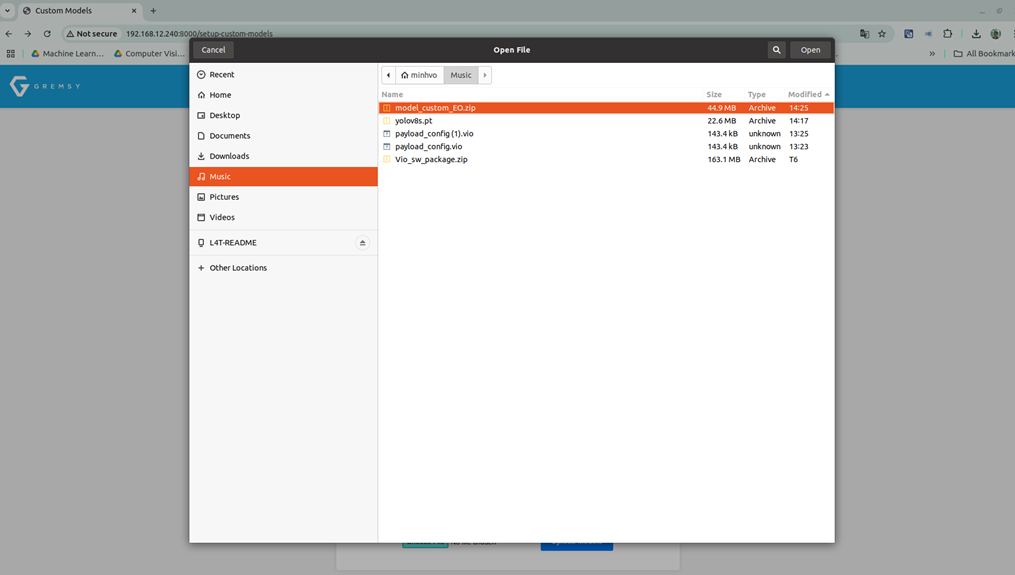
* In the Upload Models tab, click on Choose File and select the **model\_custom\_{EO/IR}.zip** file.

<figure><img src="/files/rJoG9WIfOdaX2qt6m6X8" alt=""><figcaption><p>Figure 2: Model upload and conversion page</p></figcaption></figure>

<figure><img src="/files/AzBjyFoG1QcilRN4HISb" alt=""><figcaption><p>Figure 3: Tab to upload the model</p></figcaption></figure>

* After selecting the file and clicking`Open`, press `Upload Models`.

<figure><img src="/files/fRLwFiDEuznDNp9CEySj" alt=""><figcaption><p>Figure 4: Select the converted model file downloaded from Colab</p></figcaption></figure>

* Then click on the `Convert` option to process the model.

<figure><img src="/files/C59svcsFiIYh14kXB9AJ" alt=""><figcaption><p>Figure 5: Status after successfully uploading the zip file containing the model</p></figcaption></figure>

* The model conversion process will start, which may take 15–30 minutes. Please ensure the VIO payload remains powered on and do not navigate away from the page.

<figure><img src="/files/yd00Eu1hr81OSQY89FCq" alt=""><figcaption><p>Figure 6: Confirmation dialog when you press Convert Model</p></figcaption></figure>

<figure><img src="/files/yNaSm9M9r2OviksixQfw" alt=""><figcaption><p>Figure 7: Model conversion in progress</p></figcaption></figure>

* A success notification will appear after the conversion, and the payload will automatically restart its program.

<figure><img src="/files/MYpTA4iGfg8BgYN7RAX0" alt=""><figcaption><p>Figure 8: Notification of successful model conversion</p></figcaption></figure>

After the conversion is successful, your model will appear under the corresponding camera section you selected, with the name `USER_EO_CUSTOM_CONFIG`. Please select `USER_EO_CUSTOM_CONFIG` and click `Apply`.

<figure><img src="/files/lehwcH3J8d9OmCFPwMUd" alt=""><figcaption><p>Figure 9: USER_EO_CUSTOM_CONFIG displayed after successful conversion</p></figcaption></figure>

* Finally, switch to the `Detection` mode to start using the model.


---

# Agent Instructions: Querying This Documentation

If you need additional information that is not directly available in this page, you can query the documentation dynamically by asking a question.

Perform an HTTP GET request on the current page URL with the `ask` query parameter:

```
GET https://docs.gremsy.com/payloads/vio/software-configuration/vio-settings-app/custom-models.md?ask=<question>
```

The question should be specific, self-contained, and written in natural language.
The response will contain a direct answer to the question and relevant excerpts and sources from the documentation.

Use this mechanism when the answer is not explicitly present in the current page, you need clarification or additional context, or you want to retrieve related documentation sections.