# Camera Settings Menu

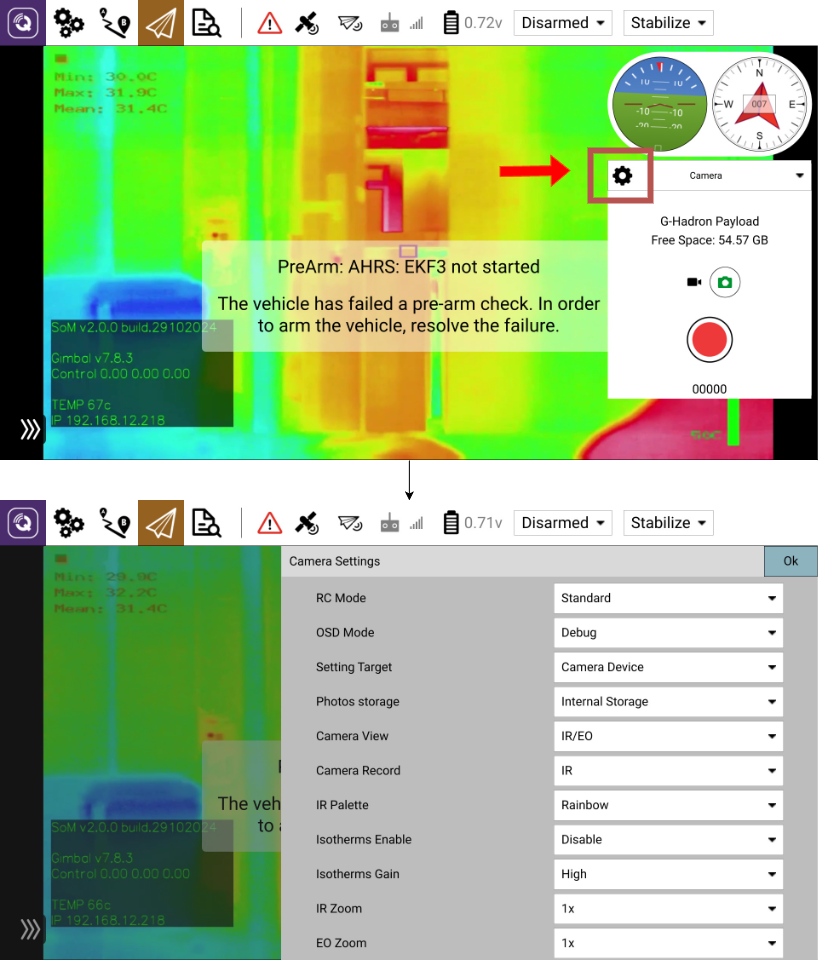
After successfully connecting G-Hadron with Autopilot:

<figure><img src="/files/j56Xy1hGivY1mvwTduck" alt=""><figcaption></figcaption></figure>

## **1. RC Mode (Remote Controller Mode)**

Payload control by remote.

There are 2 options:

* **Standard:** Pan and Tilt channels will be the speed value.
* **Gremsy**: Pan channel will be the speed value; Tilt channel will be the axis selection value *(assigned to a button on the remote)*

## **2. OSD Mode**

Set *“On Screen Display”* mode.

There are 3 modes to choose from:

* **Disable:** turn off the OSD feature; do not overlay on the screen.
* **Debug:** display Debug parameters on the screen.
* **Status:** display the operating parameters of the system on the screen.

## **3. Setting Target**

Select module settings:&#x20;

* **Camera Device:** settings for the camera.
* **Gimbal Device**: settings for gimbal.
* **Advances features:** settings for detection and tracking.

## **4. Camera device settings**

<figure><img src="/files/MKIuQYT80xFqB99UeZMK" alt=""><figcaption></figcaption></figure>

### **4.1. Photos Storage**

Select location to storage media files:

* Internal Storage
* SD Card&#x20;

### **4.2. Camera View**

Set camera source to display:

* EO/IR
* EO
* IR
* IR/EO

### **4.3. Camera Record**

Set camera source to record

* EO and IR
* EO
* IR
* OSD

### **4.4. IR Palette**

Set palette color for IR camera

<figure><img src="/files/kLdkdlct0TBxW77JI7I1" alt=""><figcaption></figcaption></figure>

### **4.5. Isotherms Enable**

* Isotherms allows configuration of ranges of temperatures or % to have customized colorization.
* This can be used for highlighting objects of certain temperatures with radiometric cameras, while still using the 8-bit colorized output.
* There are 2 options:
  * Disable
  * Enable

Set data for Isotherms at Payload Web Server

{% content-ref url="/spaces/nikHUDUd2JXqkOsnOi7l/pages/1OnJsNY2owsv8UVQDb48" %}
[PAYLOAD WEB SERVER](/tiny-gimbal/g-hadron/payload-web-server.md)
{% endcontent-ref %}

### **4.6. Isotherms Gain**

* Isotherm options set to proper temperature units and the gain mode:
  * Low gain is for high temperature measurement.
  * High gain is for low temperature measurement.

### **4.7. IR Zoom**

Set the Zoom level for the IR camera

The zoom values **from 1x to 8x**

### **4.8. EO Zoom**

Set the Zoom level for the EO camera

The zoom values from **1x to 12x**

### **4.9. Camera Optimizations**

<table><thead><tr><th width="91" align="center">Value</th><th width="174">Field Name</th><th>Description</th></tr></thead><tbody><tr><td align="center">0</td><td>Disabled</td><td>Indicates that no scene modes are set.</td></tr><tr><td align="center">1</td><td>Face-Priority</td><td>Optimized for photos of with priority of people faces.</td></tr><tr><td align="center">2</td><td>Action</td><td>Optimized for photos of quickly moving objects.</td></tr><tr><td align="center">3</td><td>Portrait</td><td>Optimized for still photos of people.</td></tr><tr><td align="center">4</td><td>Landscape</td><td>Optimized for photos of distant macroscopic objects.</td></tr><tr><td align="center">5</td><td>Night</td><td>Optimized for low-light settings.</td></tr><tr><td align="center">6</td><td>Night-Portrait</td><td>Optimized for still photos of people in low-light settings.</td></tr><tr><td align="center">7</td><td>Theatre</td><td>Optimized for dim, indoor settings where flash must remain off.</td></tr><tr><td align="center">8</td><td>Beach</td><td>Optimized for bright, outdoor beach settings.</td></tr><tr><td align="center">9</td><td>Snow</td><td>Optimized for bright, outdoor settings containing snow.</td></tr><tr><td align="center">10</td><td>Sunset</td><td>Optimized for scenes of the setting sun.</td></tr><tr><td align="center">11</td><td>Steady-Photo</td><td>Optimized to avoid blurry photos due to small amounts of device motion <em>(for example: due to hand shake).</em></td></tr><tr><td align="center">12</td><td>Fireworks</td><td>Optimized for nighttime photos of fireworks.</td></tr><tr><td align="center">13</td><td>Sports</td><td>Optimized for photos of quickly moving people.</td></tr><tr><td align="center">14</td><td>Party</td><td>Optimized for dim, indoor settings with multiple moving people.</td></tr><tr><td align="center">15</td><td>Candlelight</td><td>Optimized for dim settings where the main light source is a candle.</td></tr><tr><td align="center">16</td><td>HDR</td><td>Turn on a device-specific high dynamic range (HDR) mode.</td></tr></tbody></table>

### **4.10.  AE Compensation**

Auto Exposure Compensation.&#x20;

* Range: -12 - 12&#x20;
* Default: 0

### **4.11. White Balance**

White Balance mode:

<table><thead><tr><th width="92">Value</th><th width="178">Field Name</th><th>Description</th></tr></thead><tbody><tr><td>0</td><td>Off</td><td>Both auto and manual white balance routines are disabled.</td></tr><tr><td>1</td><td>Manual-CC-Temp</td><td><em>The auto-</em>white balance routine is inactive and manual color correction temperature is used which is set via the <strong>'manual-wb-settings'</strong> property.</td></tr><tr><td>2</td><td>Manual-RGB-Gains</td><td><em>The auto-</em>white balance routine is inactive and manual R/G/B gains are used which are set via the <strong>'manual-wb-settings'</strong> property.</td></tr><tr><td>3</td><td>Auto</td><td><em>The auto-</em>white balance routine is active.</td></tr><tr><td>4</td><td>Shade</td><td>The camera device uses shade light as the assumed scene illumination for white balance correction.</td></tr><tr><td>5</td><td>Incandescent</td><td>The camera device uses incandescent light as the assumed scene illumination for white balance correction.</td></tr><tr><td>6</td><td>Fluorescent</td><td>The camera device uses fluorescent light as the assumed scene illumination for white balance correction.</td></tr><tr><td>7</td><td>Warm-Fluorescent</td><td>The camera device uses warm fluorescent light as the assumed scene illumination for white balance correction.</td></tr><tr><td>8</td><td>Daylight</td><td>The camera device uses daylight light as the assumed scene illumination for white balance correction.</td></tr><tr><td>9</td><td>Cloudy-Daylight</td><td>The camera device uses cloudy daylight light as the assumed scene illumination for white balance correction.</td></tr><tr><td>10</td><td>Twilight</td><td>The camera device uses twilight light as the assumed scene illumination for white balance correction.</td></tr></tbody></table>

### **4.12. ISO**

ISO exposure mode:

<table><thead><tr><th width="95">Value</th><th width="158">Field Name</th><th>Description</th></tr></thead><tbody><tr><td>0</td><td>Auto</td><td>The ISO exposure mode will be chosen depending on the scene.</td></tr><tr><td>1</td><td>Deblur</td><td>The ISO exposure sensitivity set to prioritize motion deblur.</td></tr><tr><td>2</td><td>100</td><td>The ISO exposure sensitivity set to prioritize level 100.</td></tr><tr><td>3</td><td>200</td><td>The ISO exposure sensitivity set to prioritize level 200.</td></tr><tr><td>4</td><td>400</td><td>The ISO exposure sensitivity set to prioritize level 400.</td></tr><tr><td>5</td><td>800</td><td>The ISO exposure sensitivity set to prioritize level 800.</td></tr><tr><td>6</td><td>1600</td><td>The ISO exposure sensitivity set to prioritize level 1600.</td></tr><tr><td>7</td><td>3200</td><td>The ISO exposure sensitivity set to prioritize level 3200.</td></tr></tbody></table>

### **4.13. Sharpness**

Image Sharpness Strength.&#x20;

* Range: 0 - 6&#x20;
* Default: 2.

### **4.14. Reset Camera Defaults:**

Set the camera settings to default, then restart the payload

### **4.15. Storage**

Format SD Card

<figure><img src="/files/aG1tbBsnntQf0UStRK7R" alt=""><figcaption></figcaption></figure>

<br>


---

# Agent Instructions: Querying This Documentation

If you need additional information that is not directly available in this page, you can query the documentation dynamically by asking a question.

Perform an HTTP GET request on the current page URL with the `ask` query parameter:

```
GET https://docs.gremsy.com/tiny-gimbal/g-hadron/camera-setting-menu/camera-settings-menu.md?ask=<question>
```

The question should be specific, self-contained, and written in natural language.
The response will contain a direct answer to the question and relevant excerpts and sources from the documentation.

Use this mechanism when the answer is not explicitly present in the current page, you need clarification or additional context, or you want to retrieve related documentation sections.
